BREAKING: Trump Announces Venezuela to Transfer 30–50 Million Barrels of Oil to the United States
- By Metropolix ~
- January 8, 2026 --
- 0 Comment

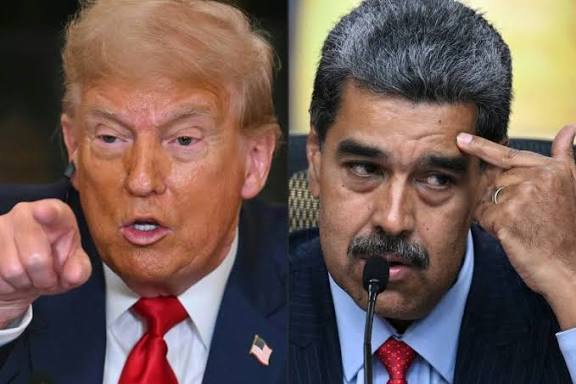
—Trump, Maduro
By Cyril Kingsley and Philips Morgan (reporting from US)
In a move that is already reshaping global energy and geopolitical conversations, United States President Donald Trump has announced that Venezuela will transfer between 30 million and 50 million barrels of crude oil to the United States. The development marks one of the most significant shifts in U.S.–Venezuela relations in decades and has triggered intense debate over energy security, international law, and the future of Venezuela’s oil sector.
According to the announcement, the oil will be shipped to the United States and sold at prevailing market prices, with the proceeds to be managed under the authority of the U.S. government. President Trump stated that the funds generated from the sale would be used in ways that benefit both the American people and Venezuelans, framing the arrangement as a strategic and humanitarian measure.
What Trump Announced:
President Trump disclosed that Venezuela’s interim authorities have agreed to “turn over” between 30 and 50 million barrels of oil to the United States. He described the crude as high-quality oil that had been effectively stranded due to years of sanctions, export limitations, and political instability in Venezuela.
The U.S. president said the oil would be transported directly to American ports, sold at market prices, and that the revenue would be placed under U.S. oversight. He further noted that the initiative would be implemented immediately, with the U.S. Department of Energy tasked with coordinating logistics and execution.
While Trump did not provide a detailed breakdown of how the proceeds would be allocated, he emphasized that the funds would be used responsibly and transparently, presenting the deal as both an economic and moral intervention.
Political Context Behind the Decision
The announcement comes amid dramatic political changes in Venezuela. Years of economic collapse, international sanctions, and internal unrest have severely weakened the country’s oil industry, once the backbone of its economy and a major supplier to global markets.
Venezuela holds the largest proven crude oil reserves in the world, yet its production has plummeted over the past decade due to underinvestment, deteriorating infrastructure, mismanagement, and sanctions. Output that once exceeded three million barrels per day has fallen to a fraction of that figure.
The new arrangement reflects Washington’s growing influence over Venezuela’s transitional political framework and signals a sharp departure from past stalemates that left much of the country’s oil wealth inaccessible.
How the Oil Transfer Will Work under the plan outlined by President Trump:
Between 30 million and 50 million barrels of Venezuelan crude oil will be transferred to the United States.
The oil will be shipped using storage tankers and delivered to U.S. ports.
Once received, the crude will be sold at prevailing global market prices.
The revenue from the sales will be managed by the U.S. government:
The funds are expected to be used in ways that benefit both Venezuelan recovery efforts and U.S. interests.
Although exact timelines and logistical details have not been fully disclosed, energy officials indicate that preparations are already underway to facilitate the shipments.
Estimated Value and Market Impact:
At current global oil prices, the oil transfer could be valued at approximately $2 billion to $3 billion, depending on final volumes and pricing. While significant, analysts note that the volume represents only a small portion of global oil consumption and a modest share of U.S. daily demand.
However, markets responded swiftly to the announcement, with oil prices experiencing downward pressure amid expectations of increased supply. Traders and investors are now assessing how the additional barrels could affect short-term price movements and broader supply-demand balances.
Energy experts caution that while the immediate market impact may be limited, the geopolitical implications could be far-reaching, particularly if the deal signals deeper U.S. involvement in Venezuela’s oil sector.
For the United States, the agreement offers several strategic advantages:
First, it strengthens energy security by increasing access to oil supplies from the Western Hemisphere, reducing reliance on more distant or politically sensitive sources.
Second, it reinforces U.S. influence in Latin America at a time when global competitors have expanded their presence in the region. Venezuela has historically supplied oil to countries outside the Western alliance, and redirecting barrels to the U.S. alters longstanding trade patterns.
Third, it allows Washington to exert leverage over how Venezuelan oil revenues are used, potentially shaping the country’s political and economic recovery.
President Trump framed the move as a practical solution to prevent oil wealth from being misused while simultaneously delivering economic benefits.
Implications for Venezuela:
For Venezuela, the oil transfer represents both an opportunity and a challenge. On one hand, the deal unlocks oil assets that have been sitting idle due to sanctions and export barriers. The revenue generated could provide much-needed financial relief to a country grappling with hyperinflation, infrastructure collapse, and humanitarian challenges.
On the other hand, critics argue that ceding control over oil sales and proceeds raises serious questions about sovereignty and long-term economic independence. Venezuela’s oil industry requires massive reinvestment, modernization, and technical expertise to return to sustainable production levels.
Analysts warn that without a clear roadmap for rebuilding the sector and restoring domestic control, the country risks remaining dependent on external actors for access to its most valuable resource.
International Reaction:
The announcement has sparked polarized reactions across the international community.
Supporters argue that the deal prevents Venezuelan oil from being wasted while ensuring that revenues are not siphoned off through corruption or inefficiency. They view it as a pragmatic step that could stabilize energy markets and provide financial resources for reconstruction.
Critics, however, describe the move as an unprecedented assertion of control over another nation’s natural resources. Some legal scholars have raised concerns about the implications for international law, particularly regarding state sovereignty and resource ownership.
Several countries are also closely watching how the arrangement might affect global oil trade flows, especially nations that have historically purchased Venezuelan crude.
Role of U.S. Oil Companies:
The announcement has renewed speculation about the potential involvement of major U.S. oil companies in Venezuela. American firms possess the technical expertise and capital needed to rehabilitate Venezuela’s aging oil infrastructure, but past experiences, including asset nationalization, have made them cautious.
Industry analysts believe the oil transfer could be a precursor to broader agreements that open the door to investment, production-sharing arrangements, or service contracts under new political conditions.
However, any long-term engagement would require clear legal frameworks, security guarantees, and assurances against future expropriation.
Broader Geopolitical Implications:
Beyond energy markets, the deal highlights how natural resources continue to serve as tools of diplomacy and leverage. Control over oil flows has long influenced global power dynamics, and this development underscores the strategic importance of energy in foreign policy decision-making.
The move also reflects shifting priorities in U.S. foreign policy, with a renewed focus on assertive action, economic leverage, and direct outcomes.
Observers note that the arrangement could redefine relations not only between Washington and Caracas, but also between the U.S. and other energy-producing nations watching how the situation unfolds.
What Happens Next:
Attention will now turn to implementation. Key questions remain unanswered, including the precise timeline for shipments, the mechanisms for managing proceeds, and the extent to which Venezuelan authorities will participate in oversight.
Legal challenges, diplomatic negotiations, and political pushback are all possible as the deal moves from announcement to execution.
For energy markets, investors will continue to monitor whether additional Venezuelan barrels enter global supply chains and whether this signals a longer-term reconfiguration of production and trade.
Conclusion:
President Trump’s announcement that Venezuela will transfer 30–50 million barrels of oil to the United States marks a watershed moment in international energy and diplomatic relations. While the immediate economic impact may be limited, the political, legal, and strategic implications are profound.
As the plan unfolds, it will test the balance between pragmatism and principle, cooperation and control, and national interest versus global norms. What remains clear is that Venezuela’s oil — long a symbol of both immense wealth and deep crisis — has once again become central to global power calculations.
RELATED ARTICLES