Tinubu’s Visit Will Provide Opportunity To Further Operationalize The Nigeria-UK Strategic Partnership — Chattam House Gives Highlights
- By Metropolix ~
- March 17, 2026 --
- 0 Comment

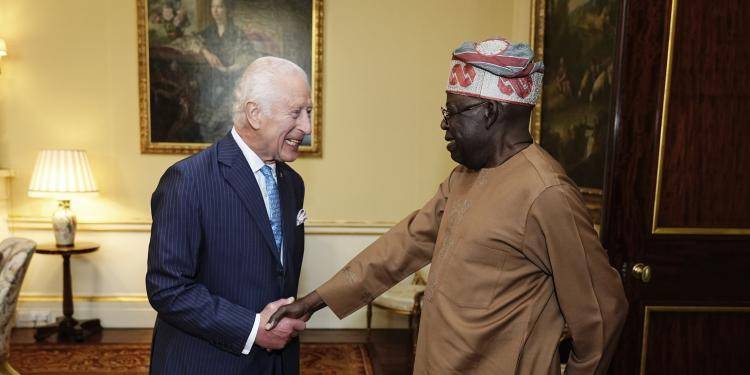
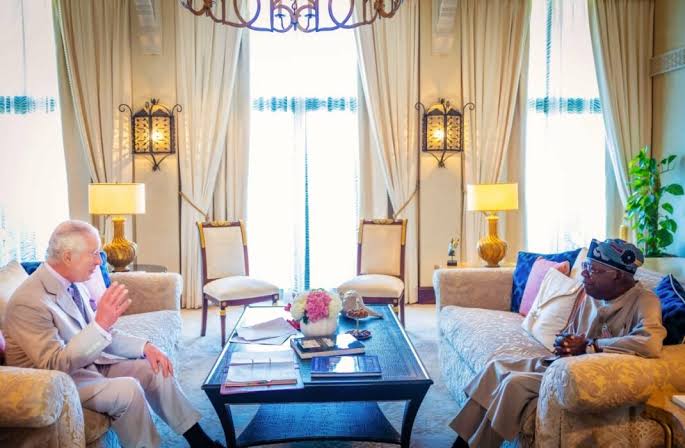
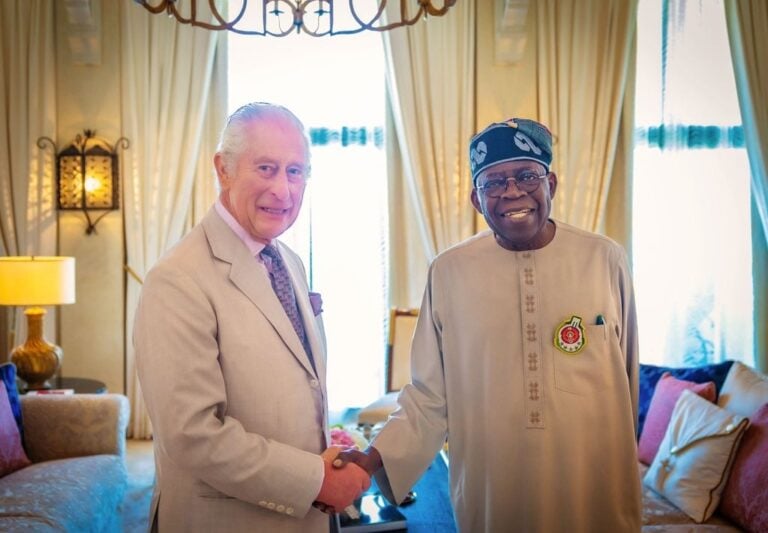
– King Charles receiving President Tinubu in his office
By Cyril Kingsley in London
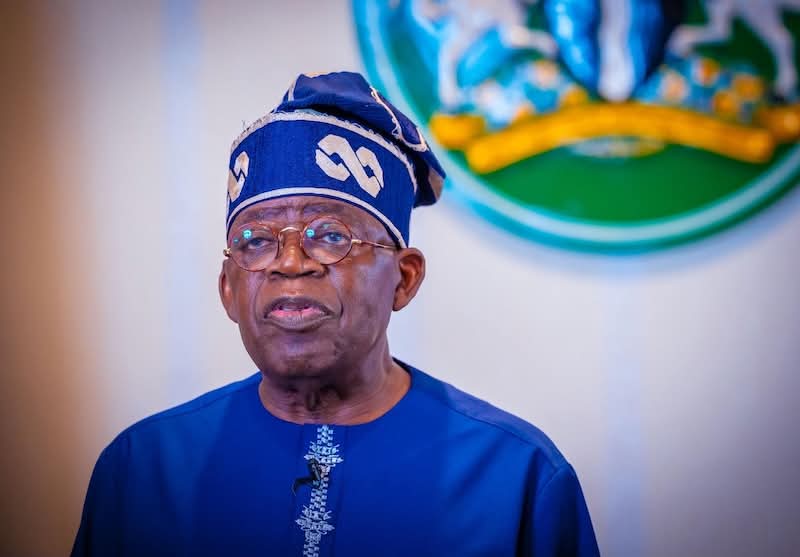
President Bola Ahmed Tinubu’s state visit to the UK this week is the first by a Nigerian leader since General Ibrahim Babangida in 1989.
Hosted by King Charles III, a state visit is the UK’s highest level of diplomatic visit and uses royal ceremony to signal and strengthen relations with key partners. It is being framed in Abuja as a landmark moment, showcasing the ‘unique bond’ between the two countries and inaugurating ‘a new era of cooperation’.
Tinubu’s visit will provide an opportunity to further operationalize the Nigeria-UK Strategic Partnership, signed in November 2024 during Foreign Secretary David Lammy’s visit to Nigeria, and the February 2024 Enhanced Trade and Investment Partnership (ETIP).
The visit is also in line with Tinubu’s embrace of a foreign policy approach that centres high-profile meetings and visible diplomacy. Tinubu’s foreign policy has been rhetorically polished and sometimes strategically astute; it reflects Nigeria’s profile as a regional power and a key Commonwealth state, and has opened channels for deeper economic and security cooperation.
But nearly three years into Tinubu’s presidency, the key question is whether this visibility-driven foreign policy has delivered domestic gains.
So far, the president’s prominent international profile has not largely translated into improvements in material conditions for most Nigerians.
High-profile diplomacy, uneven domestic dividends
Tinubu has engaged in frequent presidential travel, maintaining a visible presence at summits across Europe, the Middle East, Asia and Africa. His trips – and those of senior officials – have drawn criticism for their cost amid rising poverty, hunger and falling purchasing power back home.
Foreign minister Yusuf Tuggar has articulated a ‘4D Foreign Policy’ – built on democracy, development, demography and diaspora – and advocated for Nigeria’s strategic autonomy. But in practice, Nigeria’s diplomatic capacity has lagged behind its rhetoric. Ambassadorial appointments have been slow or seen as politicized, weakening diplomatic capacity to implement the administration’s agenda.
Minister for Foreign Affairs Samuel Okudzeto Ablakwa and Minister of Foreign Affairs Yusuf Maitama Tuggar speaking at the Chatham House event.
Tinubu’s administration has also sought international validation for its key domestic reforms – fuel subsidy removal, naira devaluation and tax reform. His team cites various policy achievements as proof of success. These include headline inflation falling from above 30 per cent in 2024 to around 15 per cent last month; a stabilizing naira; Nigeria’s removal from the Financial Action Task Force’s (FATF) grey list; S&P raising its outlook to ‘positive’; and renewed investor interest.
However, for many Nigerians, the combination of subsidy removal, devaluation and tougher taxation with weak safety nets recalls the ‘shock therapy’ of the late 1980s, when IMF-aligned reforms under General Babangida produced lasting social costs.
Poverty remains high, food insecurity has risen, household spending remains weak and credit remains expensive for small firms. Growth is concentrated in capital-intensive sectors such as finance and ICT, while agriculture remain constrained by insecurity and structural bottlenecks. Nigeria’s deficits in education, skills and health are having a more negative impact on future earnings than in other comparable economies.
Investment welcome, but deeper trade issues remain
Tinubu’s London visit will likely focus on leveraging the UK-Nigeria ETIP to attract investment in energy, infrastructure, technology and services – sectors where UK firms are competitive. However, any potential investments are unlikely to fix Nigeria’s struggling economy or reverse the structural drivers of migration, such as rampant insecurity and weak public services.
UK-Nigeria trade is significant, but not top-tier. It reached £8.1 billion in figures for 2025, up 11.4 per cent on the preceding year. Nigeria is the UK’s 36th largest trading partner, with the balance of trade in the UK’s favour. In comparison, Nigeria’s trade with China exceeded $22 billion (around £16.5 billion) between January and October 2025.
The UK is also a major source of FDI and a key destination for Nigerian migrants. Nigerians were one of the largest non-EU nationalities to immigrate to the UK in 2025, and remittances form an important element of Nigeria’s external accounts.
Most of Nigeria’s work needs to be done back home.
However, much of Nigeria’s non-African commerce is still dominated by hydrocarbons and imported manufactured goods, rather than higher-value non-oil exports. This pattern leaves the country vulnerable to commodity price swings and reflects structural constraints at home: roughly 85 million Nigerians still lack access to grid power. Despite a new Electricity Act in 2023, outcomes remain poor, with frequent outages.
Nigeria’s trade with other African countries also remains low. Nigeria earned roughly $478 million from exports to ECOWAS markets in 2025 – a comparatively modest amount. Despite Abuja’s vocal support for the African Continental Free Trade Agreement and its plans to host the fifth Intra-African Trade Fair (IATF) in 2027, African markets remain underexploited.
While Tinubu may secure UK investment during his visit, these deeper patterns raise doubts about whether this economic diplomacy is reducing Nigeria’s reliance on non-African trade or its exposure to global shocks. Instead, more focus is needed on tackling long-term structural challenges – especially in electricity, education and health.
Security cooperation
Security should also be a key focus of the visit. Nigeria remains locked in conflicts across multiple fronts. The jihadist insurgency in the northeast continues, while organized criminality and kidnappings plague the northwest and central Nigeria. Nigeria ranks 6th on the 2025 Global Terrorism Index.
In early February, Nigeria’s Ministry of Defence announced the deepening of defence cooperation with the UK, building on existing training, intelligence, counterterrorism and maritime cooperation. The state visit is expected to formalize and expand this agenda, potentially improving operational capabilities.
So far, security partnerships with the UK and others have improved technical capacity – particularly in maritime security, counter-IED work and some aspects of air operations. But they have not produced discernible improvement in everyday security.
Killings, kidnappings and displacement remain widespread. ACLED data indicates at least 12,860 people were killed in political violence in the past year.
Tuggar has emphasized the importance of local security solutions in West Africa. Abuja has positioned itself as a democratic counterweight in a region marked by coups and insecurity spreading from the Sahel into coastal West Africa. Yet Nigeria’s growing relations with France under Tinubu have arguably complicated its diplomacy with the Alliance of Sahel States (AES) amid anti-French sentiment in the Sahel.
Nigeria’s role as a regional anchor is undeniable and recognized internationally. But the state’s basic protective functions at home remain weak. Narrow operational gains from external security cooperation are insufficient without parallel progress on security sector reform, local governance justice and accountability.
Linking foreign policy to domestic impact
With Nigeria’s general elections due in 2027, the domestic stakes of the UK visit are high. After the controversial 2023 elections, perception of a governing elite focused on international optics risks deepening political cynicism.
The administration will likely present any new UK investment announcements or security agreements as evidence that its reformist, outward-looking foreign policy is paying off. Such claims will be closely scrutinized at home. Measured against the core test of governance – whether citizens are safer, less poor and more hopeful – the dividends of Tinubu’s foreign policy have been marginal so far.
The UK state visit is an opportunity not merely to court praise and promises, but to prioritize tangible outcomes for ordinary Nigerians. For example, Tinubu could seek ambitious UK support to build on existing police reform efforts and move towards decentralized, multi-level policing that strengthens community-based security alongside federal forces.
Ultimately, most of Nigeria’s work needs to be done back home. Otherwise, Nigeria risks continuing a foreign policy that looks impressive abroad but fails to tackle the country’s fundamental issues.
Reports from Chattam House
RELATED ARTICLES